If you’ve been researching ecological landscaping, you’ve probably heard that native plants are the best choice for your garden. While that’s often true, one question comes up again and again:
Does my garden need to be 100% native?
The short answer is no.
A beautiful, healthy garden doesn’t have to be made entirely of native plants. The goal is to create a landscape that supports nature while also fitting your home, your lifestyle, and your personal taste.
Why Native Plants Matter
Native plants have evolved alongside our local wildlife for thousands of years. They provide food and habitat for pollinators, birds, and beneficial insects, while also being naturally adapted to Westchester’s climate and soils.
Because they’re well suited to our region, native plants often:
- Require less water once established
- Need fewer fertilizers and chemicals
- Support butterflies, bees, and birds
- Handle local weather conditions well
Adding more native plants is one of the easiest ways to make your garden more environmentally friendly.
But Native Doesn’t Mean “Only Native”
Many homeowners love plants like hydrangeas, peonies, boxwoods, roses, or Japanese maples. These aren’t native to the Northeast, but many are well-behaved, non-invasive plants that can thrive for decades.
The real problem isn’t that a plant comes from another country.
The problem is when a plant becomes invasive.
Invasive plants spread aggressively, escape into natural areas, and crowd out the native plants that wildlife depends on. They reduce biodiversity and can be very difficult to remove once established.
That’s why ecological garden design focuses less on where every single plant originated and more on how the entire garden functions.
Designing a Balanced Garden
In many of my projects, I combine native plants with carefully selected non-native species.
For example, I may use:
- Native perennials to support pollinators.
- Native shrubs to provide berries and shelter for birds.
- A few ornamental plants that offer year-round structure or flowers homeowners love.
- Evergreen shrubs that provide winter interest and privacy.
This approach creates gardens that are beautiful, practical, and ecologically valuable.
The result doesn’t look wild or messy—it looks thoughtfully designed.
Every Property Is Different
There isn’t one perfect recipe for every landscape.
A shady woodland garden has different needs than a sunny front yard. Some properties have heavy deer pressure, difficult soils, or very specific design styles.
That’s why every garden should be designed individually rather than following a strict rule.
The best ecological gardens work with the conditions of the site while gradually increasing biodiversity over time.
Our Philosophy at Jade Garden Design
At Jade Garden Design, we believe ecological landscaping is about making thoughtful choices—not following rigid rules.
Whenever possible, we prioritize native plants because of the enormous value they provide to local ecosystems. But we also recognize that well-chosen, non-invasive ornamental plants can play an important role in creating gardens that homeowners truly enjoy.
A successful garden should support wildlife, fit the character of your home, be manageable to maintain, and bring you joy every time you step outside.
Because when people love their gardens, they take care of them—and that’s good for both homeowners and nature.
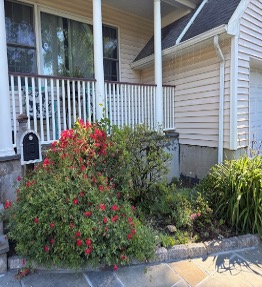
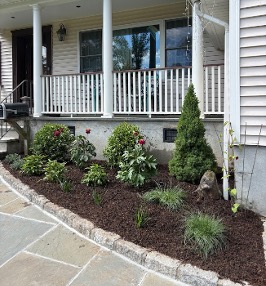
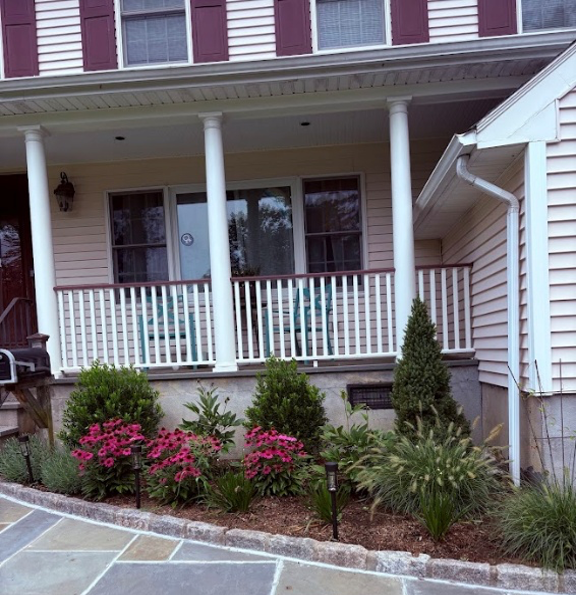
Before → Just planted → 2 months later.
Front garden designed and installed in Mamaroneck, NY. A low-maintenance, deer-resistant planting that combines native species with carefully selected non-invasive ornamentals. Spruce and Ilex glabra provide year-round structure, while peonies, coneflowers, lavender, alliums, and ornamental grasses bring seasonal color, texture, and pollinator value.